
Introduction
Indonesia’s post-pandemic education recovery policies stand at a critical crossroads. Substantial state budget allocations directed toward school digitalization, device distribution, and the widespread adoption of a new curriculum initially generated visual optimism among the public. However, once the administrative veil is lifted and longitudinal data from the National Assessment (AN) spanning 2021–2025 is subjected to rigorous econometric analysis, we are forced to confront a sobering reality: our primary education system is encountering structural saturation.
Drawing on over 109,000 school-level observations encompassing both elementary schools (SD) and Islamic primary schools (MI), this analysis dissects the asymmetric cognitive performance across these institutions. The findings do more than just reveal who is leading on paper; they expose potentially fatal risks embedded within the very educational intervention strategies we have long celebrated.
The Anatomy of Cognitive Performance: The Dichotomy of Absolute Achievement and Resilience
To map out how actual baseline literacy and numeracy trajectories shifted across the population during the evaluation period, we must examine the absolute trend lines. The following chart projects the achievement levels comparing SD and MI from 2021 through 2025.
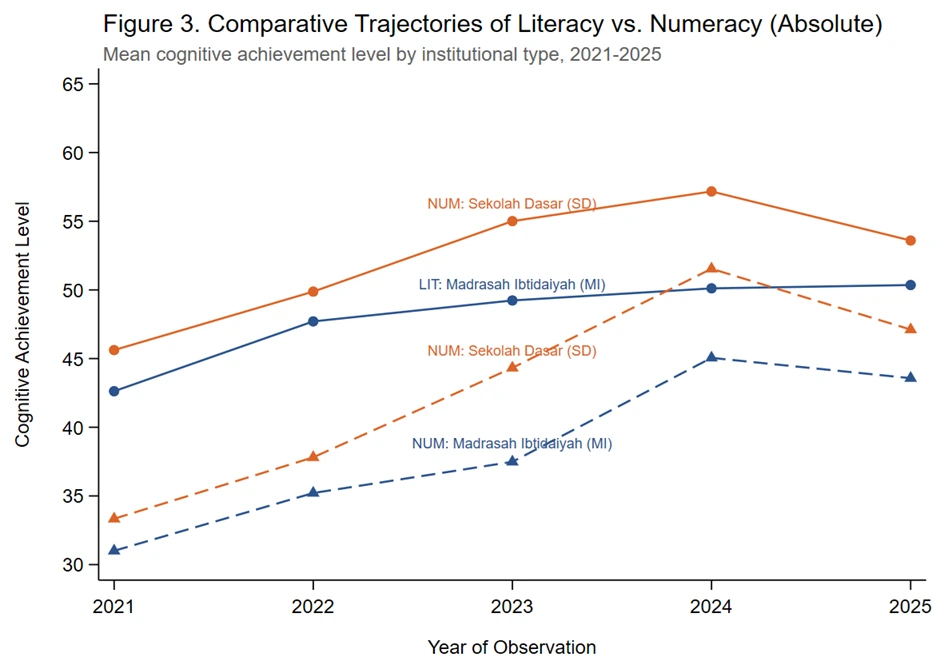
The absolute trend lines clearly reveal a persistent performance dichotomy. At a macro level, SDs consistently occupy the upper cluster of the Y-axis, while MIs remain in the lower cluster. Nonetheless, resilience dynamics display a unique pattern. The MI group demonstrated a robust domestic resilience cushion during the initial phases of the crisis (2021–2022). Even without aggressive external stimuli, internal cognitive acceleration within MIs progressed steadily. This underscores the powerful role of religious-social capital—the close-knit madrasah community that sustained independent learning when formal bureaucracy stalled. Conversely, SDs experienced an exponential surge in 2023–2024 driven by the shock effect of mass digitalization interventions, only to face an immediate downturn in 2025.
The 2025 Early Warning: The Threat of a Policy-Induced Sugar Rush Effect
Regrettably, the optimism surrounding the 2023–2024 SD performance surge came at a heavy cost by 2025. A sharp decline in the SD numeracy curve combined with a stagnant trend in literacy indicates deep-seated structural fragility. To validate whether this 2025 trend shift is statistically grounded or merely random fluctuation, we examine the estimates from the Fixed Effects panel regression model below, which captures the interaction parameters between time and institutional type.
Table 1. Fixed Effects Panel Regression Estimates
| Variables | (1) Model 1: LIT | (2) Model 2: NUM |
|---|---|---|
| 2021.year | 0.000 | 0.000 |
| (.) | (.) | |
| 2024.year | 3.483*** | 11.408*** |
| (0.571) | (0.423) | |
| 2025.year | 3.487*** | 9.742*** |
| (0.555) | (0.487) | |
| 1.institution_type_num | 0.000 | 0.000 |
| (.) | (.) | |
| 2.institution_type_num | 0.000 | 0.000 |
| (.) | (.) | |
| 2021.year#1.institution_type_num | 0.000 | 0.000 |
| (.) | (.) | |
| 2021.year#2.institution_type_num | 0.000 | 0.000 |
| (.) | (.) | |
| 2024.year#1.institution_type_num | 0.000 | 0.000 |
| (.) | (.) | |
| 2024.year#2.institution_type_num | 3.903*** | 4.062*** |
| (0.558) | (0.413) | |
| 2025.year#1.institution_type_num | 0.000 | 0.000 |
| (.) | (.) | |
| 2025.year#2.institution_type_num | -0.399 | 0.806 |
| (0.539) | (0.477) | |
| SES_student | -0.730*** | -0.491*** |
| (0.026) | (0.020) | |
| SES_school | -0.009 | -0.036** |
| (0.014) | (0.011) | |
| _cons | 85.419*** | 62.113*** |
| (1.629) | (1.268) | |
| R-squared (Within) | 0.355 | 0.651 |
| F-Statistic | 3450.285 | 12005.546 |
| Prob > F | 0.000 | 0.000 |
| Observations | 65,783 | 65,790 |
Note: Standard errors are in parentheses.
* p < 0.05, ** p < 0.01, *** p < 0.001
The panel regression results provide crucial empirical validation for what we term a policy-driven temporary shock effect. The interaction coefficients reveal that by 2025, the accelerated cognitive advantage that SDs held over MIs evaporated significantly, losing its primary statistical power (p > 0.05). Interventions acting as cosmetic stimuli—such as mass digital device procurement and mandatory administrative reporting apps for teachers—proved capable of boosting student cognitive performance only in the short term, akin to a temporary energy spike following high sugar consumption. Once this shock effect faded, the education system reverted back to its true structural ceiling of pedagogical capacity. Conversely, the MI cohort, left untouched by interventions as aggressive as those in SDs, displayed a far more stable long-term trajectory devoid of drastic downward corrections.
Empirical Validation: The Dual Nature of Foundational Competencies
This decomposition of cognitive determinants also offers a pivotal theoretical contribution by validating fundamental differences in how core competencies function. To observe how internal school factors interact with household socioeconomic backgrounds and geographic isolation, let us re-examine the comparison of goodness-of-fit parameters and control variable significance summarized across Model 1 and Model 2 in Table 1 above.
The data cleanly maps out two distinct typologies of cognitive competencies, revealing profound socio-economic relationships:
- Numeracy as a School-Dependent Skill: After simultaneously controlling for student background, the numeracy model demonstrates a very powerful explanatory power (within R-squared) of 65.1%. Interestingly, when socio-economic capital is broken down across multiple levels, the individual-level variable (SES_student) yields a highly significant negative coefficient of -0.491 ($p < 0.001$), while the school-level aggregate (SES_school) remains statistically significant at the 1% level with a coefficient of -0.036 ($p < 0.01$). This finding indicates a paradigm shift: while numeracy remains highly school-dependent with a dominant model fit, socioeconomic disparities at both the individual and environmental levels empirically drag down the recovery rate. This creates tangible structural hurdles, meaning institutional school interventions can no longer be evaluated in isolation from the economic deprivation students face outside the classroom.
- Literacy as a Culture-Dependent Skill: For the literacy model, the within R-squared following model corrections stands at 35.5%. When parsing socioeconomic backgrounds multi-levelly, variation in inter-temporal literacy gains is overwhelmingly driven by student domestic factors, where the SES_student variable exerts a highly significant negative effect of -0.730 ($p < 0.001$). Conversely, once omitted variable bias is corrected, the aggregated SES_school variable completely loses its statistical power, shifting to an insignificant coefficient of -0.009 ($p > 0.05$). This provides empirical proof that literacy is deeply culture-dependent, embedded firmly within a student’s individual habitus. Because the Fixed Effects (FE) model mechanically eliminates constant spatial variables like regional status (Rural vs. Urban), the loss of significance for SES_school shows that literacy interventions can no longer rely on physical, school-level infrastructure policies. Instead, they must directly target disparities in cultural capital and home literacy practices.
Conclusions & Recommendations
The failure to sustain cognitive growth trends into 2025 serves as a loud wake-up call for national primary education planning. This analysis outlines three structural corrective measures tailored to the realities of multi-level socioeconomic barriers:
- Macro Fiscal Reorientation: Balancing Hardware Capital Expenditure with Pedagogical Capacity Building
It is time to pivot macro fiscal planning away from its heavy over-reliance on the mass physical procurement of digital devices, toward operational expenditures dedicated to strengthening teacher capacity. This is not to dismiss the value of digital tools in modern classrooms, but rather to align priorities properly. Deploying hardware without instructional readiness triggers nothing more than a sugar rush—a fleeting spike followed by stagnation. Digital technology is not a silver bullet operating in a vacuum; the efficacy of any device in a student’s hands is bound entirely by the structural ceiling of the teacher’s pedagogical skill guiding them. - Targeted Interventions in MI Mathematics Management Linked with Economic Mitigation
Although numeracy is theoretically a school-dependent skill, the updated model proves that socioeconomic gaps at the individual level (SES_student = -0.491) and school cluster level (SES_school = -0.036) actively choke the recovery of mathematics competency. Consequently, uniform curriculum standardization is insufficient. Accelerating numeracy within the MI track must be coupled with affirmative support. This includes targeted scholarships or operational subsidies tailored specifically for madrasahs situated within lower economic strata to buffer the negative impacts of structural deprivation. - Decentralized Literacy Movements Rooted in Affirmative Individual Habitus within Rural Regions
The finding that literacy is hyper-sensitive to individual background (SES_student = -0.730) confirms that boosting reading skills cannot be solved simply by shipping books to school libraries. Because the burden of literacy lag is anchored to the student’s domestic habitus, the government should leverage local social structures—which, in the case of MIs, means religious-social capital. Integrating literacy initiatives directly into family ecosystems, community reading spaces, and local religious groups will break down cultural capital deficits right at the household level.