
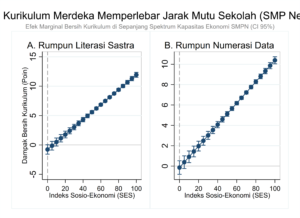
Structural Inequality and the Kurikulum Merdeka in Junior Secondary Education
This cross-cognitive empirical evidence reinforces the conclusion that the Kurikulum Merdeka aligns with findings at the Senior Secondary (SMA) level. The policy consistently perpetuates social class biases in competencies reliant on hard physical infrastructure (Numeracy), yet successfully triggers a democratizing effect in competencies that are autonomous, culturally grounded, and supported by standardized, free digital tools (Literacy).
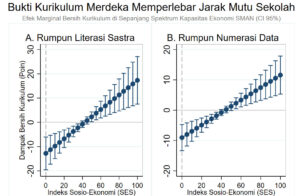
How Kurikulum Merdeka is Fueling Inequality in Public High Schools
Accelerating the quality of upper secondary education in Indonesia is currently confronted with global demands that shift away from merely […]

Gender and Geographical Challenges to Public Secondary Education Quality in Indonesia”
The acceleration of upper secondary education quality in Indonesia is currently confronted with global demands that transcend rote memorization. The […]

Geography as Cognitive Destiny in Public Vocational Schools
Rural schools experience structural isolation from industrial networks, leaving their students’ cognitive achievements lagging far behind. The primary challenge facing vocational education today lies not within curriculum documents, but in the glaring inequalities of industrial capital embedded in the very ground where these schools stand.
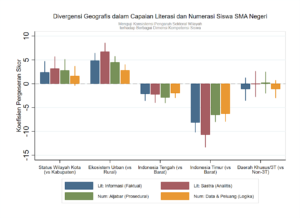
Cognitive Skills, Spatial Inequalities, and the Efficiency of Educational Inputs
Upper secondary education development policies are heavily driven by administrative standardization, particularly through a unified national curriculum intended to equalize […]

Data-Driven School Leadership Boosts Teacher Quality
Within the Data-Driven Reflection (RSD) cluster, both the green plot (SMA) and the orange plot (SMK) rest safely to the right of the 0 baseline. This provides visual validation that evidence-based management led by school principals possesses universal efficacy across differing institutional landscapes. Objective data offers clear, actionable guidance for principals to guide their teaching staff effectively.

The Leadership-Execution Gap: Why the Merdeka Curriculum Stalls at the Classroom Door
The greatest hurdle facing the Merdeka Curriculum today is not taming school bureaucracies, but entering remote classrooms, supporting vocational and madrasah educators, and dismantling conventional teaching cultures that have yet to be liberated.

Beyond the Curriculum: The Hidden Drivers Behind the Academic Leap in Madrasah Aliyah
Indonesia must avoid getting trapped in the mere glorification of the Merdeka Curriculum’s administrative rollout. If the government evaluates educational quality solely based on the readiness of paperwork or formal surveys of teacher instruction, it will remain blind to the living social and cultural capital built into frameworks like the madrasah

Orchestrating National Risk: The Quest for a Centralized Framework
In an era of disruption defined by asymmetric crises and domino effects, existential threats to a nation no longer follow […]
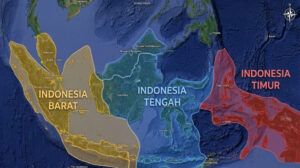
Spatial Analysis of Kurikulum Merdeka
This study examines the spatial impact of Indonesia’s Kurikulum Merdeka on rural primary students using a longitudinal Fixed Effects model (2021–2025) across Western, Central, and Eastern regions. The findings reveal a stark policy divergence. In numeracy, the curriculum drives universal, highly significant gains (p0.1). Critical Realist analysis reveals that household-level poverty acts as a structural ceiling, neutralizing administrative reforms. Consequently, closing the regional cognitive gap demands structurally affirmative interventions—such as nutritional support and targeted logistics—rather than mere curricular changes
The Merdeka Paradox: Emancipated Curriculum and Structural Dysfunction in Rural Indonesia
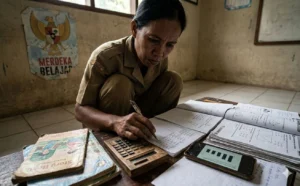
Utilizing a Panel Fixed Effects framework on longitudinal data (2021–2025), this study exposes an acute structural dysfunction within Indonesia's "Emancipated Curriculum" across rural primary schools. While aggregate numeracy scores superficially surged by 12.30 points, cognitive recovery remains deeply asymmetric. Gains are heavily concentrated in procedural sub-domains like Algebra (+17.92 points), driven by mechanical drill-and-practice methods to meet macro accountability targets. Conversely, high-order reflective competencies like Literary Text comprehension stagnated at a mere 2.40-point increase, severely constrained by the rigid structural ceiling of household socioeconomic deprivation

Why Rural Classrooms Are Being Left Behind in the Post-Pandemic Educational Recovery?
This article dismantles the persistent urban bias in Indonesia’s educational planning, shifting the focus to structural stagnation within rural communities. Drawing on a massive longitudinal National Assessment dataset from 2021 to 2025—comprising over 47,000 observations—the analysis reveals a severe "cognitive hemorrhage" at the primary school level. By isolating rural samples and employing a rigorous Fixed Effects panel regression specification, the study effectively controls for time-invariant institutional characteristics to observe genuine policy impacts.

The Cost of Calculating: How Chasing Math Scores Drives Student Bullying in Rural Schools
The Dark Side of Academic Recovery: Unveiling a Stark Social Paradox through Panel Data from 47,000 Rural Schools and Madrasahs. […]

A Structural Ceiling: Why Indonesia’s Post-Pandemic Learning Recovery Faces Long-Term Stagnation
An econometric analysis of 109,000 primary schools reveals that Indonesia’s post-pandemic learning recovery is hitting a structural ceiling. Why mass digitalization triggered a temporary 'sugar rush'—and why long-term stagnation now looms over foundational literacy and numeracy.

Why Do Post-Pandemic Policies Deepen Cognitive Inequality?
Introduction In the wake of the Covid-19 pandemic, Indonesia’s education policy discourse has been dominated by a singular, uniform narrative: […]

Where You Are Born Dictates Your Child’s IQ
Tens of trillions of rupiah flow every year in the name of “educational equity,” yet the cognitive future of our […]

Jakarta: Financial Strength, Structural Vulnerability
The Provincial Government of DKI Jakarta cannot afford to be complacent about its current record-high revenues. Jakarta must pioneer a radical fiscal paradigm shift, redirecting its tax framework toward land-use value extraction, commonly known as Land Value Capture (LVC)

The School Welfare Paradox and the Crisis of Student Reasoning
Every year, the mandatory allocation of 20 percent of the state and regional budgets for education is loudly heralded as […]

The Vocational Challenge: Aligning Facility Investments with Graduate Well-Being
Introduction The government has consistently positioned vocational education (Vocational High Schools / SMK) as a strategic pillar for developing a […]

Managing Mega-Programs? Lessons to Lean from the MBG
On the Risk front, the MBG faces acute legal vulnerability due to the absence of a dedicated statutory law (Undang-Undang). Over-reliance on administrative decrees (Presidential Regulations/Technical Guidelines) triggers uncertainty, as evidenced by a judicial review filed at the Constitutional Court by the Taman Belajar (TB) Nusantara Foundation against the 2026 State Budget Law.
Breaking Free from the Export Enclave Trap: Supply Chain Sovereignty and the Future of Exports
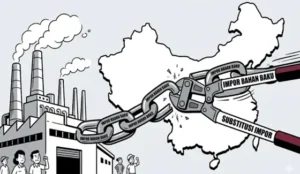
Indonesia risk becoming nothing more than a "glorified assembly line" (a nation of tailors), where the bulk of foreign exchange earned from exports is immediately funneled back overseas to finance raw materials

Reclaiming the Education Budget as an Instrument of Social Justice
A budget is not merely a string of numbers on a working paper; it is a concrete mechanism to ensure that every Indonesian child—from Sabang to Merauke, regardless of social class or geographical divide—receives their right to an equal quality of education.

Extractive Enclaves and the Development Trap: Why Resource-Rich Regions Continue to Lag Behind
Indonesia's commodity-producing regions remain caught in a cycle of extractive dependence. Despite generating substantial volumes of coal, palm oil, minerals, fisheries products, and other primary commodities, many of these regions struggle to convert resource wealth into sustainable economic development. Rather than capturing greater value from their natural assets, local economies remain heavily reliant on the export of raw materials, leaving them highly vulnerable to fluctuations in global commodity markets.