
The acceleration of upper secondary education quality in Indonesia is currently confronted with global demands that transcend rote memorization. The current paradigm shifts assessments toward evaluation of Higher Order Thinking Skills (HOTS). Utilizing a longitudinal panel dataset spanning 2021-2025 across public senior high schools (SMAN) in Indonesia, an integrated estimation model was constructed to dissect the primary determinants of student learning. This analysis evaluates cognitive verbal proficiency through Literary Literacy and statistical-logical reasoning via Data Numeracy. Employing a Random Effects estimation framework with standard errors clustered at the school level, the study reveals several compelling insights. The findings not only expose deep-seated spatial disparities across regions but also unveil a structural paradox rooted in gender dynamics.
Gender-related structural issues have long remained obscured from national policy agendas. The most intriguing finding within this model lies in the coefficient of the female student proportion at the institutional level. Individually, traditional educational sociology tends to position female students as superior in verbal domains and academic compliance; however, when evaluated at the aggregate school level, the panel data refutes this premise. In Literary Literacy, an increased proportion of female students correlates negatively with the school’s average verbal performance. Meanwhile, in Data Numeracy, this negative impact doubles in magnitude and exhibits absolute statistical significance.
Confronted with this phenomenon, we must avoid superficial, unsubstantiated conclusions suggesting that female students inherently possess lower cognitive capacities. Rather, this massive negative value is driven by layered causal structures. Authentic HOTS assessment instruments inherently demand logical inference, the deconstruction of lengthy texts, and probability analysis under strict time constraints.
In classrooms heavily dominated by a single gender, peer dynamics tend to stifle competitive and rigorous argument dialectics—elements crucial for stimulating critical verbal reasoning. This condition is further exacerbated by a collective math anxiety syndrome at the upper secondary level.
High concentrations of female students at the school level trigger a contagion of numerical aversion due to the lack of group heterogeneity capable of breaking quantitative-logic instructional deadlocks. Empirically, this condition is proven to heavily depress Data Numeracy scores by up to 7.187 points with absolute significance (p < 0.01). Furthermore, beyond the school gates, socio-cultural structures continue to impose a significantly heavier burden of domestic responsibilities on young girls. When a school has a high female concentration, the cumulative study time lost at home generates a double blow that aggregates into a 3.541-point reduction in the institution’s average score for cognitive verbal competence (Literary Literacy).
Conversely, internal governance and school-level interventions exhibit varied performance in mitigating cognitive risks. The implementation of macro policies like the “Kurikulum Merdeka” (Independent Curriculum) has yet to demonstrate a statistically significant breakthrough, displaying passive coefficients across both models. On the other hand, strengthening human capital and the school’s psychosocial environment yields highly consistent leverage. Each incremental increase in the proportion of certified teachers accelerates literacy scores by 0.123 points and numeracy scores by 0.073 points in absolute terms. This impact is further reinforced by the school safety climate, where robust anti-bullying environments contribute a massive cognitive incentive of 0.469 points to verbal capability and 0.305 points to data reasoning. This sequence of internal governance, gender composition, and human capital interventions at the school level is documented in detail in the following table:
Table 1 Integrated Model: Spatial, Gender, Governance, and Infrastructure in Public Senior High Schools (SMAN)
| Variables | Lit: Literature (Verbal) | Num: Data (Logic) |
|---|---|---|
| female | -3.541* | -7.187*** |
| (2.146) | (1.527) | |
| class_density_ratio | 0.704 | 0.988* |
| (0.763) | (0.570) | |
| merdeka_dummy | -0.297 | -0.578 |
| (0.733) | (0.564) | |
| certified_teachers_prop | 0.123*** | 0.073*** |
| (0.022) | (0.017) | |
| school_SES | 0.218*** | 0.174*** |
| (0.039) | (0.028) | |
| WEL | 0.028 | -0.002 |
| (0.042) | (0.034) | |
| BUL | 0.469*** | 0.305*** |
| (0.061) | (0.044) |
Standard errors in parentheses. * p < 0.10, ** p < 0.05, *** p < 0.01
Although school-level internal dynamics and student characteristics provide tangible contributions, the landscape of educational quality disparities in Indonesia cannot be decoupled from macro-external factors that fall beyond the immediate control of school administrations. Further econometric analysis supports the argument that students’ critical thinking outcomes are firmly locked by spatial-geographical variables. Shifting the analytical focus from internal capacity toward regional landscapes reveals how heavily a school’s geographic positioning dictates educational outcomes.
Table 2 Integrated Model: Spatial, Gender, Governance, and Infrastructure in Public Senior High Schools (SMAN) (Continued)
| Variables | Lit: Literature (Verbal) | Num: Data (Logic) |
|---|---|---|
| urban_dummy | 3.587*** | 2.319*** |
| (0.950) | (0.658) | |
| municipality_dummy | 2.053 | 2.241** |
| (1.263) | (1.086) | |
| central_region_dummy | -1.603** | -1.654*** |
| (0.813) | (0.546) | |
| eastern_region_dummy | -8.750*** | -6.065*** |
| (1.290) | (0.877) | |
| _cons | 14.559*** | 21.905*** |
| (4.146) | (2.827) | |
| N | 618 | 618 |
| R2 | 0.630 | 0.622 |
| rho | 0.617 | 0.490 |
Standard errors in parentheses. * p < 0.10, ** p < 0.05, *** p < 0.01
The results demonstrate that the asymmetry in HOTS attainment across Indonesia is rigidly locked by spatial-geographical variables. Severe structural issues afflict the Eastern region, which suffers the deepest deficit in cognitive attainment, namely a drop of 8.750 points in Literary Literacy and 6.065 points in Data Numeracy. This pattern confirms structural hurdles in the form of cumulative language capital disadvantages—where standard Indonesian often serves as a second language in the East—alongside chronic inequality in the distribution of facilities supporting the literacy ecosystem. This regional disparity is also observed in Central Indonesia, which encounters a consistent downward pressure of approximately 1.6 points across both domains.
In sharp contrast, urban ecosystems act as a formidable buffer of cultural capital and digital infrastructure, yielding a massive compensatory advantage of 3.587 points in the verbal domain and 2.319 points in numeracy. Interestingly, the model proves that constraints in physical infrastructure do not inevitably culminate in cognitive paralysis. The classroom density variable displays a significant positive anomaly in Data Numeracy, increasing outcomes by 0.988 points. This finding indicates a “favored urban school” phenomenon, where crowded and dense classrooms still successfully generate leaps in data reasoning because their ecosystems are populated by highly competitive student inputs and supported by municipal administrative status, which contributes an additional premium of 2.241 points. The stability of all variables is validated by highly robust R2 values. The variations within the model account for up to 63% of the dynamics in Literary Literacy and 62.2% in the Data Numeracy domain.
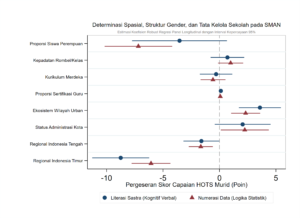
Figure 1 illustrates unambiguous evidence that the confidence intervals for the female student proportion and the Eastern region reside entirely to the left of the zero threshold. Consequently, this analysis puts forward two primary strategic recommendations for policymakers. First, the government must redesign pedagogical frameworks to be gender-responsive in order to alleviate collective math anxiety in schools with high female concentrations through cooperative statistical-logic learning methods. Second, there is an urgent need to deploy asymmetric affirmative policies for Eastern Indonesia through literacy interventions tailored to local socio-linguistic contexts, coupled with an equitable distribution of highly qualified educators to these marginalized regions.