
New Approaches, Enduring Structural Pathologies
Efforts to accelerate educational quality at the junior secondary level (SMPN) have shifted away from evaluating mere short-term rote memorization. With the implementation of the Kurikulum Merdeka (Independent Curriculum), learning objectives have been redirected toward sharpening students’ logical-contextual reasoning, as measured by the national Education Report Card (Rapor Pendidikan). This analysis examines longitudinal panel data from 2021–2025 across Indonesia’s entire SMPN ecosystem. It explores the impact of this curricular transition on two fundamental cognitive domains: Literary Literacy (LIT) and Data Numeracy (NUM). Utilizing a Fixed Effects (FE) panel data estimation method with standard errors clustered at the school level, this analysis incorporates continuous quadratic interaction terms to isolate how a school’s socioeconomic status (SES) moderates the efficacy of this decentralized learning policy over time.
The analysis accounts for core variables, including baseline internal school governance, demographic characteristics, and access to basic physical capital. It further evaluates the direct interaction between these variables and student performance trends before and after the policy became mandatory. The first part of this analysis estimates the empirical impact on the numeracy domain, tracing how net performance gains are distributed nationally, as detailed in the data matrix below.
Table 1. Fixed Effects (FE) Estimation of the Kurikulum Merdeka Impact on SMPN NUM Scores
| Variable (NUM) | Coef. | St.Err. | t-value | p-value | [95% Conf. Interval] | Sig | |
|---|---|---|---|---|---|---|---|
| SES_sekolah | -.087 | .005 | -17.19 | 0.000 | -.096 | -.077 | *** |
| 2021 (baseline) | 0.000 | . | . | . | . | . | |
| 2022 | -2.569 | .332 | -7.74 | 0.000 | -3.220 | -1.918 | *** |
| 2023 | -2.311 | .454 | -5.09 | 0.000 | -3.201 | -1.420 | *** |
| 2024 | -1.172 | .522 | -2.25 | 0.025 | -2.195 | -.149 | ** |
| 2025 | -1.355 | 1.189 | -1.14 | 0.254 | -3.686 | 0.975 | |
| 2022 × SES_sekolah | .019 | .007 | 2.60 | 0.009 | .005 | .033 | *** |
| 2023 × SES_sekolah | .133 | .007 | 20.29 | 0.000 | .120 | .146 | *** |
| 2024 × SES_sekolah | .137 | .007 | 19.71 | 0.000 | .123 | .150 | *** |
| 2025 × SES_sekolah | .120 | .008 | 14.49 | 0.000 | .104 | .136 | *** |
| prop_female | -.073 | .355 | -0.21 | 0.837 | -.769 | .623 | |
| proporsi_pendidik_s1 | -.022 | .012 | -1.85 | 0.064 | -.045 | .001 | * |
| proporsi_pendidik_sertifikasi | -.018 | .003 | -6.21 | 0.000 | -.023 | -.012 | *** |
| jumlah_komp_milik | -.029 | .009 | -3.15 | 0.002 | -.047 | -.011 | *** |
| Constant | 61.006 | 1.194 | 51.09 | 0.000 | 58.665 | 63.346 | *** |
| Mean dependent var: 57.288 | SD dependent var: 7.747 | Number of obs: 36,588 | |||||
| R-squared: 0.510 | F-test: 1898.766 | AIC: 201806.062 | |||||
Table 1 reveals a compelling structural anomaly in the quantitative domain. While the direct effect of the time variable in the year of full policy adoption (2025.tahun) is no longer statistically significant (-1.355; p > 0.10), the multiplicative interaction coefficient between the policy year and the school’s economic index (2025.tahun#c.SES_sekolah) shows a robust positive return of +0.120, with absolute significance (p < 0.01). These findings confirm that the Kurikulum Merdeka has triggered a structural shift in capital leverage. School economic status—which offered no immediate advantage during the 2021 baseline—has evolved into a highly productive performance-enhancing instrument as implementation has matured.
While the accumulation of capital in numeracy demonstrates sharp polarization, the primary education ecosystem exhibits different pedagogical dynamics regarding verbal proficiency. The analysis continues by examining the impact of the new curriculum on literacy, as detailed in the table below.
Table 2. Fixed Effects (FE) Estimation of the Kurikulum Merdeka Impact on SMPN LIT Scores
| Variable (LIT) | Coef. | St.Err. | t-value | p-value | [95% Conf. Interval] | Sig | |
|---|---|---|---|---|---|---|---|
| SES_sekolah | -.054 | .007 | -7.54 | 0.000 | -.068 | -.040 | *** |
| 2021 (baseline) | 0.000 | . | . | . | . | . | |
| 2022 | 1.656 | .510 | 3.25 | 0.001 | .657 | 2.655 | *** |
| 2023 | 1.274 | .585 | 2.18 | 0.029 | .127 | 2.420 | ** |
| 2024 | 1.342 | .698 | 1.92 | 0.055 | -.026 | 2.710 | * |
| 2025 | 3.970 | 1.572 | 2.53 | 0.012 | .890 | 7.051 | ** |
| 2022 × SES_sekolah | .012 | .011 | 1.17 | 0.244 | -.008 | .033 | |
| 2023 × SES_sekolah | .096 | .008 | 11.39 | 0.000 | .079 | .112 | *** |
| 2024 × SES_sekolah | .114 | .009 | 12.21 | 0.000 | .095 | .132 | *** |
| 2025 × SES_sekolah | .090 | .010 | 8.69 | 0.000 | .070 | .111 | *** |
| prop_female | -2.130 | .453 | -4.70 | 0.000 | -3.019 | -1.242 | *** |
| proporsi_pendidik_s1 | -.019 | .015 | -1.25 | 0.210 | -.050 | .011 | |
| proporsi_pendidik_sertifikasi | -.001 | .003 | -0.37 | 0.714 | -.008 | .006 | |
| jumlah_komp_milik | -.002 | .012 | -0.14 | 0.892 | -.025 | .022 | |
| Constant | 63.367 | 1.563 | 40.54 | 0.000 | 60.303 | 66.431 | *** |
| Mean dependent var: 63.462 | SD dependent var: 11.462 | Number of obs: 36,585 | |||||
| R-squared: 0.440 | F-test: 1503.386 | AIC: 219555.409 | |||||
Figure 1. Net Marginal Effect of Curricular Transition on SMPN LIT and NUM Outcomes
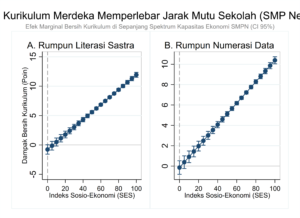
Figure 1 confirms how the structural mechanisms of the Kurikulum Merdeka operate divergently. In Panel B (Numeracy), the net impact trend line rises sharply from left to right. For low-SES schools, the 95% Confidence Interval crosses the zero baseline, indicating that the new curriculum yields no significant performance incentive for schools in lower economic tiers. Conversely, for high-SES schools, the surplus gains increase linearly, peaking at +11 points. This stands in stark contrast to Panel A (Literacy), where the net impact trend line rises in parallel, maintaining a steady trajectory across all economic levels and securing equitable gains for both lower-resource (+4 points) and higher-resource schools (+13 points).
This cross-cognitive empirical evidence reinforces the conclusion that the Kurikulum Merdeka aligns with findings at the Senior Secondary (SMA) level. The policy consistently perpetuates social class biases in competencies reliant on hard physical infrastructure (Numeracy), yet successfully triggers a democratizing effect in competencies that are autonomous, culturally grounded, and supported by standardized, free digital tools (Literacy).