English

Dampak kurikulum merdeka pada jenjang smp
English

Structural Inequality and the Kurikulum Merdeka in Junior Secondary Education

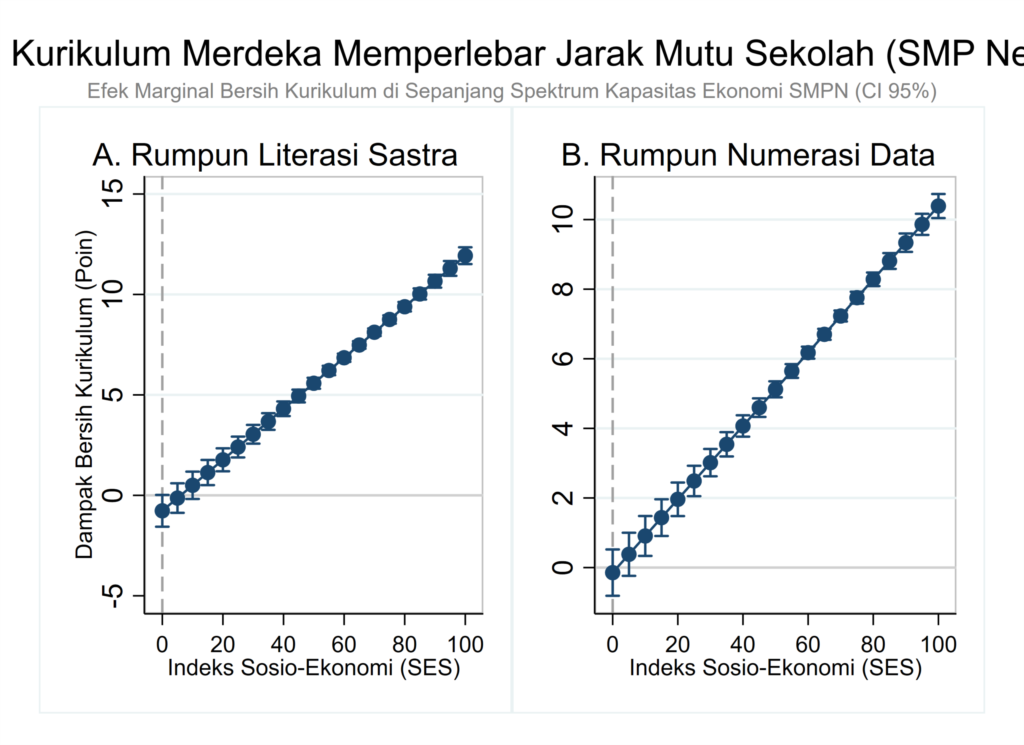
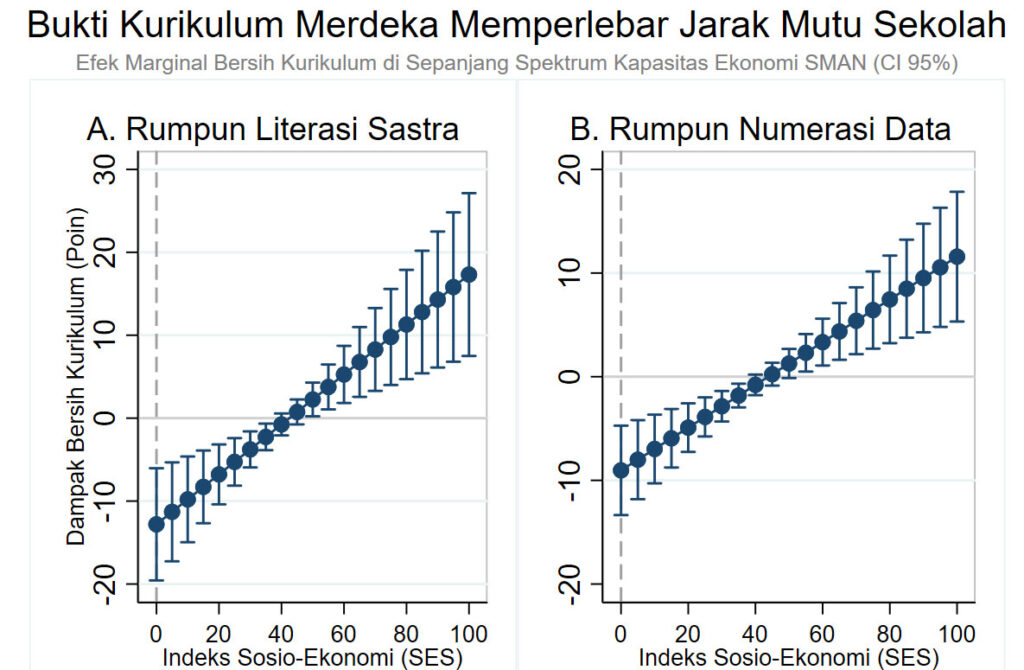
This cross-cognitive empirical evidence reinforces the conclusion that the Kurikulum Merdeka aligns with findings at the Senior Secondary (SMA) level. The policy consistently perpetuates social class biases in competencies reliant on hard physical infrastructure (Numeracy), yet successfully triggers a democratizing effect in competencies that are autonomous, culturally grounded, and supported by standardized, free digital tools (Literacy).

Structural Inequality and the Kurikulum Merdeka in Junior Secondary Education Read Post »
principal
English

Data-Driven School Leadership Boosts Teacher Quality

Within the Data-Driven Reflection (RSD) cluster, both the green plot (SMA) and the orange plot (SMK) rest safely to the right of the 0 baseline. This provides visual validation that evidence-based management led by school principals possesses universal efficacy across differing institutional landscapes. Objective data offers clear, actionable guidance for principals to guide their teaching staff effectively.

Data-Driven School Leadership Boosts Teacher Quality Read Post »

madrasah aliyah school performance
English

Beyond the Curriculum: The Hidden Drivers Behind the Academic Leap in Madrasah Aliyah

Indonesia must avoid getting trapped in the mere glorification of the Merdeka Curriculum’s administrative rollout. If the government evaluates educational quality solely based on the readiness of paperwork or formal surveys of teacher instruction, it will remain blind to the living social and cultural capital built into frameworks like the madrasah

Beyond the Curriculum: The Hidden Drivers Behind the Academic Leap in Madrasah Aliyah Read Post »

Analisis spasial dampak Kurikulum Merdeka di wilayah Barat, Tengah, dan Timur Indonesia
English

Spatial Analysis of Kurikulum Merdeka

This study examines the spatial impact of Indonesia’s Kurikulum Merdeka on rural primary students using a longitudinal Fixed Effects model (2021–2025) across Western, Central, and Eastern regions. The findings reveal a stark policy divergence. In numeracy, the curriculum drives universal, highly significant gains (p<0.01) nationwide, demonstrating the power of streamlined institutional instruction. Conversely, literacy gains stall completely in Eastern Indonesia (0.633, p>0.1). Critical Realist analysis reveals that household-level poverty acts as a structural ceiling, neutralizing administrative reforms. Consequently, closing the regional cognitive gap demands structurally affirmative interventions—such as nutritional support and targeted logistics—rather than mere curricular changes

Spatial Analysis of Kurikulum Merdeka Read Post »

Scroll to Top